The movement is the
world beyond it.

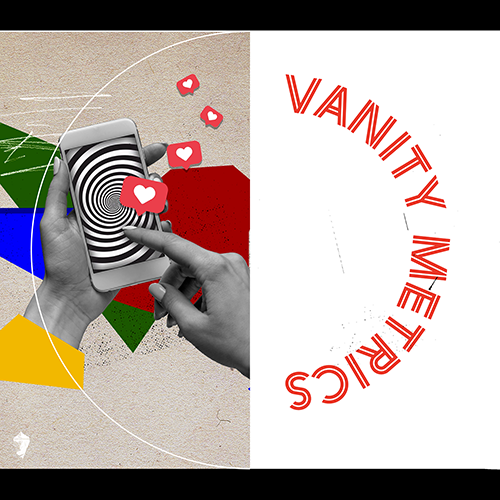

Vanity Metrics examines the strange contradiction of modern digital life: we have become increasingly capable of measuring attention while remaining remarkably uncertain about what that attention means.
Set against a warm, minimalist groove of deep bass, crisp drums, Rhodes piano and atmospheric synthesisers, the song explores how digital platforms turn complex human experiences into simple, comparable numbers.
The opening verse introduces a familiar ritual: checking dashboards, refreshing pages and watching engagement rise. Each notification offers a brief moment of satisfaction, yet the underlying need for recognition remains unresolved.
The song's central question emerges through the contrast between visibility and understanding:
"Got a hundred thousand eyes looking at the screen / But nobody really knows what the spaces mean."
Visibility is not the same as recognition. An audience may see a carefully constructed version of someone without understanding the person behind it.
The chorus exposes the emotional cost of this confusion. While the numbers rise, something less measurable may be disappearing: spontaneity, childhood curiosity, authentic expression and the pleasure of creating without anticipating an audience.
The second verse turns the criticism inward. Rather than presenting digital platforms as the sole problem, the narrator recognises their own participation in the system. The question "Am I a person or a percentage today?" captures the moment when measurement begins to influence identity.
Within The Invisible Matters, this represents a particular form of resolution mismatch. Metrics can accurately describe certain forms of activity without adequately representing the human experience behind them. The danger arises when these limited measurements acquire authority over personal worth, creativity or belonging.
The bridge introduces a possible interruption. Disconnecting from the network does not automatically resolve the problem, but it creates an opportunity to ask a question that the dashboard cannot answer:
"Who am I without the clout?"
The song deliberately avoids an easy victory. Its closing sequence—"Just a metric... Refresh one more time. Going offline."—captures the tension between recognising a behavioural pattern and actually escaping it.
Musically, the contradiction is intentional. The production is polished, warm and inviting. The groove makes the listener want to return, even as the lyrics question the mechanisms that keep people returning to their screens.
Vanity Metrics is therefore not an argument against measurement or technology. It is a reminder that what can be counted must not automatically become what counts.
Vanity Metrics
**(Verse 1)**
Staring at the glass, waiting for the glow
Checking on the dashboard, watching numbers grow
Refresh the page, yeah, it’s a modern art
Trading pieces of my mind for a colored heart
Got a hundred thousand eyes looking at the screen
But nobody really knows what the spaces mean
We’re building up a castle out of digital sand
Hoping someone out there understands.
**(Chorus)**
Oh, we’re chasing after vanity metrics
Living life in the analytics
Counting up the highs, hiding from the lows
Does anybody care where the feeling goes?
Yeah, we love the view from the top of the grid
But we’re losing the kid and the things that we did
Oh, it’s just a vanity metric.
**(Verse 2)**
Got a notification, got a little rush
A temporary high in the evening hush
They like the aesthetic, they like the design
But it’s a curated version of this life of mine
Am I a person or a percentage today?
Did I actually have something to say?
Or am I just feeding the ghost in the machine
To stay relevant on somebody else's stream?
**(Chorus)**
Oh, we’re chasing after vanity metrics
Living life in the analytics
Counting up the highs, hiding from the lows
Does anybody care where the feeling goes?
Yeah, we love the view from the top of the grid
But we’re losing the kid and the things that we did
Oh, it’s just a vanity metric.
**(Bridge)**
Disconnect the Wi-Fi, let the signal fade
Look at the mess that the metrics made
If the screen goes black and the lights go out
Who am I without the clout?
*(Who am I? Who am I?)*
**(Chorus)**
Oh, we’re chasing after vanity metrics
Living life in the analytics
Counting up the highs, hiding from the lows
Does anybody care where the feeling goes?
Yeah, we love the view from the top of the grid
But we’re losing the kid and the things that we did
Oh, it’s just a vanity metric.
**(Outro)**
Just a metric...
Refresh one more time.
Going offline.
Vanity Metrics emerged from examining the relationship between digital attention, creative expression and personal identity.
Social media platforms provide artists and creators with unprecedented opportunities to distribute their work and reach audiences. They also introduce a powerful feedback system in which views, likes, shares and follower counts can gradually become substitutes for more difficult questions about meaning, quality and human connection.
The song explores what happens when the creator begins responding to the dashboard rather than the original creative impulse.
Its central metaphor is the vanity metric: a number that may look impressive while revealing relatively little about the outcome that actually matters.
A thousand views may represent a thousand fleeting impressions. A single encounter may transform someone's life. The dashboard can register the former much more easily than the latter.
The musical arrangement reinforces this distinction. The 85 BPM groove is spacious and controlled, combining the intimacy of neo-soul with the accessibility of bedroom pop and the rhythmic confidence of indie funk. Warm analogue textures contrast with the cold numerical world described in the lyrics.
The bridge strips away much of the production, temporarily removing the musical comfort that has carried the listener. The exposed vocal question becomes the emotional centre of the song.
The final keyboard click is particularly important. It leaves the listener uncertain whether the narrator has genuinely disconnected or is already preparing to refresh again.
Within the wider TIM catalogue, Vanity Metrics belongs to the exploration of how systems of representation can begin governing the realities they were designed to describe.
Its relationship to the TIM principle Authority ≤ Resolution is especially direct: a platform's ability to measure engagement does not give it sufficient resolution to determine a person's worth.
The song ultimately asks whether creators and audiences can recover a relationship with art, identity and one another that is not governed by the scoreboard.
Key Themes: Digital Validation • Attention Economy • Identity • Social Media • Creative Integrity • Measurement • Human Worth • Visibility vs Recognition • Behavioural Reinforcement • Authenticity • Reconnection
TIM Archive Note
Vanity Metrics makes the distinction between measurable attention and meaningful human encounter accessible through a catchy, understated song.
Its central proposition is simple:
The numbers may describe the response. They cannot contain the person.

Room Zero (Meant to Be Hot) opens the Kaiserstrasse Confessional series with a collision of familiar routines, private dissatisfaction, temptation and the intoxicating promise of anonymity.
Set between Frankfurt's nightlife and the quiet predictability of domestic life, the song follows Jason, a man whose outward circumstances suggest stability but whose inner life has become increasingly restless. A chance encounter offers the possibility of stepping outside his established identity, if only for a weekend.
The musical arrangement mirrors this division. Conversational country-pop verses, acoustic guitars and familiar storytelling give way to heavy 808 bass, trap percussion and an expansive electronic chorus. The contrast creates a deliberately uncomfortable relationship between musical exhilaration and narrative consequence. The chorus sounds triumphant even as the protagonist's certainty about himself begins to collapse.
The recurring image of Room Zero represents an apparent suspension of ordinary rules: a place where identities, commitments and consequences seem temporarily negotiable. Yet the song gradually reveals the illusion beneath that freedom. What happens inside the room does not remain there.
The bridge provides the crucial emotional reversal. The excitement of Frankfurt gives way to the domestic detail of a kitchen clock, washed dishes and an ordinary Monday morning. Nothing outwardly appears to have changed, yet Jason returns carrying experiences that have already altered his relationship with himself and the people around him.
Within The Invisible Matters, the song explores the distance between the identities people perform and the experiences they conceal. It does not reduce the protagonist to a simple moral judgement. Instead, it examines how desire, loneliness, opportunity and self-deception can combine to produce decisions whose consequences extend beyond the moment.
The closing invitation to Room Two transforms an apparent ending into the beginning of a larger story. What initially looked like a temporary escape may be becoming a pattern.
Friday night in Frankfurt, just hopped off the plane
Another long-term contract tryin' to outrun the routine train
Back home it’s 2.4 kids, a perfect picture on the wall
But the sparks turned into shadows, yeah we stopped answering the call
Now I’m sitting at a dive bar, ordering a cold Becks beer
When a voice with a sweet smile whispers right into my ear...
He said I speak a little German, I said baby I'm from home
You look like you're a long way out, sitting here all alone
I can show you a side of this city where the rules don't apply
Yeah, the Mercedes is waiting outside...
If it’s Room Zero, baby, let it slide
We’re just grinding out a living on the passenger side
We didn't cross the line, but we're touching the wire
With our hands on the steel and the bass climbing higher!
Yeah, Harold’s got the keys and the door's left ajar
And by the end of Chapter One, we won't know who we are!
(Oh, we won't know who we are...)
Next thing I know it’s 8:00 AM, concierge is on the line
There’s three people in the lobby and they say it’s showtime
Jumped in the shower, shaved the face, threw my old denim on
Met Ursula and Jennifer, now all the mapping is gone
She rubbed my jeans so subtly, a little touch in the dark
Said “I hope you ain’t working tomorrow,” yeah, she left her mark.
Now we’re star-shaped on the basement wall, losing our minds
Heavy ink and silver hoops, leaving the normal life behind
Four voices hitting the ceiling, sweating out the evidence clean
The sweetest taste of a sin that you have ever seen...
If it’s Room Zero, baby, let it slide
We’re just grinding out a living on the passenger side
We didn't cross the line, but we're touching the wire
With our hands on the steel and the bass climbing higher!
Yeah, Harold’s got the keys and the door's left ajar
And by the end of Chapter One, we won't know who we are!
Then the limo drops me back at the Monday morning light
And the kitchen clock is ticking, and the kitchen gloss is bright
She’s washing up the dishes, asking how my weekend went
While my right hand remembers every single dollar spent...
But my phone lights up a text message, screaming through the blue:
“Hey stranger, next weekend... we’re unlocking Room Two.”
Yeah, we’re heading back to Room Zero.
Just a contribution for the house, baby.
We don't know who we are.
Yeah, we don't know who we are.
Identity • Temptation • Escape • Desire • Routine • Secrecy • Self-Deception • Compartmentalisation • Consequence • Domestic Life • Anonymity • Moral Ambiguity
Kaiserstrasse Confessional Vol. I explores a recurring TIM concern: a version of ourselves may be convincing without being complete.
Jason's public identity, domestic identity and private experiences are not necessarily false representations. Each may contain something genuine. The difficulty emerges when he attempts to keep them separate, treating the consequences of one life as though they cannot reach another.
The song also demonstrates how musical form can complicate moral interpretation. Its infectious chorus does not excuse the protagonist's actions; instead, it allows the listener to experience some of the same seductive momentum that shapes his decisions.
The central tension: An experience may be hidden from other people without becoming separate from the person who lived it.

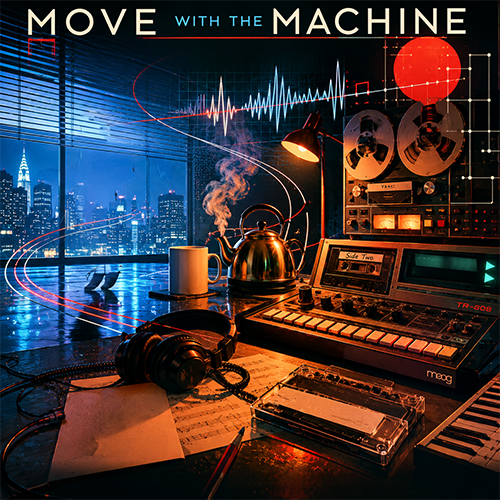
Move with the Machine inhabits the space between mechanical precision and human spontaneity. Built around the unmistakable pulse of classic electro, the song combines dry drum-machine rhythms, a warm analogue bassline, clockwork synthesisers and sparse funk instrumentation to create a sound that feels simultaneously futuristic and rooted in the underground electronic music of the late 1980s.
At 118 BPM, the arrangement is deliberately minimal. Every kick, handclap, rimshot and synthesiser phrase has a purpose. Silence becomes as important as sound, allowing the music to breathe rather than filling every available space.
The contrast between detached, almost robotic male vocals and intimate, soulful female responses introduces the song's central tension. The machine establishes the pattern, but the human voice brings vulnerability, warmth and unpredictability.
As the track progresses, subtle imperfections begin to disturb its mechanical certainty. Natural breaths, expressive vocal phrasing and a fleeting instrumental solo introduce something that cannot be entirely programmed: the character of human participation.
The recurring invitation to "move with the machine" is significant. The lyrics do not demand resistance to technology, nor do they celebrate surrendering to it. Instead, they imagine a relationship in which human creativity and technological capability can operate together without becoming indistinguishable.
Within The Invisible Matters (TIM), the song explores an increasingly important question: how can human beings participate meaningfully in a world shaped by intelligent machines without surrendering their individuality, agency or capacity for expression?
The answer is suggested through the music itself.
The machine holds the rhythm. The human being changes what that rhythm means.
And somewhere between precision and imperfection, a new groove emerges.
[Verse 1]
Midnight wires hum low
Basement lights glow slow
808 in the floor
Knocking at the door
Machine says, “Stand by”
Meters blink, comply
Hands on steel and chrome
But the beat feels like home
[Pre-Chorus]
Cut the sound, let it breathe
Leave a space underneath
Every hit lands clean
Like a pulse from a dream
[Chorus]
Move with the machine tonight
Cold sparks in the neon light
Heart and circuit side by side
Human warmth you cannot hide
Move with the machine tonight
Rhythm locked and running right
In the silence, hear it speak
Strong and spare, dark and sleek
[Verse 2]
Operator on the line
Counting every bar in time
Then a whisper slips through
Soft and honest, breaking through
Tape hiss in the air
Ghosts of sound everywhere
Bass and drums push and pull
Empty space feels beautiful
[Bridge]
Stop—
Everything disappears
One beat missing from your ears
Back again, harder now
Cowbell cuts across the crowd
Rimshot flashes, gone too soon
Bodies moving to the groove
[Chorus]
Move with the machine tonight
Cold sparks in the neon light
Heart and circuit side by side
Human warmth you cannot hide
Move with the machine tonight
Rhythm locked and running right
In the silence, hear it speak
Strong and spare, dark and sleek
[Outro]
After midnight, underground
Nothing extra, only sound
Steel and soul in equal measure
Minimal, timeless pleasure
Move with the Machine emerged from an exploration of the musical and philosophical relationship between people and technology.
Its sonic foundations draw upon the stripped-down electro movement of the late 1980s, combining the physical impact of classic drum machines with the hypnotic repetition of early experimental electronic pop. Rather than pursuing the expansive production associated with contemporary electronic dance music, the arrangement deliberately returns to simplicity: a powerful kick drum, an insistent bassline, precise percussion and carefully positioned moments of silence.
This minimalist approach reflects the song's underlying philosophy. Technology does not need to occupy every available space to be effective. Sometimes its greatest contribution is to establish a structure within which something unexpected can happen.
The male and female vocal relationship develops this idea further. The robotic voice represents repetition, consistency and control, while the soulful responses introduce breath, emotional nuance and the possibility of deviation. Neither voice needs to defeat the other.
The bridge provides the clearest expression of this relationship. The music stops, creating a moment in which the listener becomes conscious of the absence of rhythm. When the groove returns, its impact is heightened by what was temporarily removed.
This interruption is important. It demonstrates that the experience of music depends on more than the continuous production of sound. Anticipation, absence, attention and human response all contribute to meaning.
The brief instrumental solo follows the same principle. It appears, contributes something distinctive, and disappears without dominating the arrangement.
Within TIM, Move with the Machine connects directly to the idea that technological systems can expand human creative possibilities without acquiring authority over the meaning of human experience.
The song does not portray the machine as an enemy. Nor does it romanticise human imperfection as inherently superior to technical precision.
Instead, it asks what becomes possible when both contribute according to their strengths.
The machine can keep time. The human being can make something of it.
Human–Machine Collaboration • Creative Agency • Technology • Rhythm • Precision • Imperfection • Participation • Restraint • Negative Space • Human Presence • Coexistence • Expression
Move with the Machine offers a musical expression of a central TIM principle: technology can contribute to human creativity without determining its meaning.
Its significance lies in the word with.
Not against the machine.
Not beneath the machine.
Not replaced by the machine.
Move with the machine.
The relationship remains open, allowing technology to provide capability while human beings retain the freedom to interpret, respond, interrupt and create.
The song also illustrates that mechanical precision and human warmth need not cancel each other out. Their differences can become the very source of musical possibility.
The groove belongs to neither participant alone. It emerges through their encounter.


The Invisible Matters™
