The movement is the
world beyond it.



The Planet Going Pop asks two questions:
What happens when a culture cannot stop consuming? And how can so many people still lack access to safe drinking water?
Beneath its infectious electronic groove lies a troubling contradiction. Modern civilisation possesses extraordinary technological capabilities, enormous productive capacity and unprecedented access to goods, information and entertainment. Yet access to life's essentials remains profoundly unequal.
The song explores a world increasingly organised around the demand for more. More production. More consumption. More stimulation. More speed.
Its relentless 118 BPM pulse becomes a musical expression of that momentum.
Drum machines repeat. Sequencers cycle. Electronic rhythms continue with mechanical precision. The arrangement is hypnotic, seductive and deliberately difficult to resist.
This is important because the song does not portray consumption simply as something imposed upon us. It recognises its attraction. We enjoy the rhythm. We participate in it. We help keep it moving.
And somewhere beyond the dance floor, people are still waiting for water.
The contrast between technological sophistication and unmet human necessity forms the song's underlying tension. The world has developed astonishing systems for creating and distributing things people want, while access to things people need remains far from universal.
The title carries a double meaning. The planet is going pop through electronic music, commercial culture and relentless stimulation. But it also suggests a world approaching its limits—environmentally, socially and psychologically.
The sparse production reinforces this contradiction. Every sound has its place. Nothing is wasted musically. Yet the world outside the arrangement struggles with excess, scarcity and unequal distribution.
Within The Invisible Matters, the song raises questions about what societies choose to measure, reward and prioritise.
Economic activity can expand without guaranteeing human wellbeing. Technological progress can accelerate without ensuring that its benefits reach everyone.
The song does not offer a simple solution or claim that consumption alone explains global water insecurity. Instead, it asks listeners to confront the uncomfortable coexistence of abundance and deprivation.
Its central question is not whether technology, entertainment or consumption are inherently wrong.
It is whether we have become so absorbed in keeping everything moving that we have lost sight of what matters.
The planet keeps dancing. But who is being left without water?
[Chorus]
The planet going pop
The planet going pop
Everybody wants more
'Til the whole thing stops
The planet going pop
The planet going pop
We forgot what enough was
Now we're watching it pop
[Verse 1]
Another number on the screen
Another thing I didn't need
Another promise underneath
The promise underneath
Everybody's getting fed
But nobody's asleep
Everybody's getting rich
But nothing's getting deep
[Chorus]
The planet going pop
The planet going pop
Another digit added
While the water never stops
Where does it end up?
The planet going pop
Everybody getting richer
But nobody's got enough
[Verse 2]
Another update on the feed
Another reason to compete
Another signal in the noise
Another signal in the noise
Everybody's moving fast
But nobody arrives
Everybody's staying busy
Trying to feel alive
[Bridge]
Another tab I didn't close
Another thing I'm meant to know
Another voice inside the noise
Another voice inside the noise
Another hit, another click
Another second running quick
[Spoken]
A billion people looking for a drink.
[Bridge]
Just a little more should do it
One more ought to be enough
Just a little more should do it
One more ought to be enough
More, more, more, more—
'Til the whole thing—
[Silence]
[Outro Spoken]
Do you know?
The Planet Going Pop brings together two seemingly different creative impulses: a fascination with minimalist electronic dance music and a concern about the contradictions of contemporary consumer culture.
The sonic inspiration comes from the mechanical rhythms of early electro, retro-futurist synth-pop and the stripped-down electronic funk of the late 1980s.
The production's repetitive drum machines, robotic vocals and pulsing bass establish a world of relentless movement.
Yet that movement serves a larger purpose.
The music represents the extraordinary momentum of a civilisation that continually produces, purchases, consumes and replaces.
The central creative question emerges from the contrast between this momentum and the continued absence of basic necessities for vast numbers of people.
How can a world capable of producing so much still fail to provide something as fundamental as safe water?
The song's restrained arrangement makes this question more powerful by refusing to deliver it as a conventional protest anthem. Instead, the listener encounters an enjoyable, hypnotic groove whose underlying implications become increasingly unsettling.
Its human vocal interruptions, unexpected silences and brief moments of musical freedom suggest opportunities to recognise what the system's momentum can obscure.
The track ultimately leaves its questions unresolved.
The music continues.
The planet keeps moving.
And the contradiction remains.
Key Themes: Consumerism • Overconsumption • Global Inequality • Water Insecurity • Technological Progress • Environmental Limits • Human Needs • Collective Responsibility • Distraction • Abundance and Scarcity • Sustainability
The Planet Going Pop examines the distance between what a civilisation can produce and what it chooses, or manages, to make accessible.
Its central concern is not simply consumption, but the possibility that our measures of progress have become disconnected from human consequence.
A society may become extraordinarily efficient at generating abundance while remaining unable to guarantee access to life's necessities.
Within TIM, this becomes a question of attention, priorities and responsibility.
What are we keeping in motion?
What are we failing to notice?
And what happens when the planet cannot keep up?


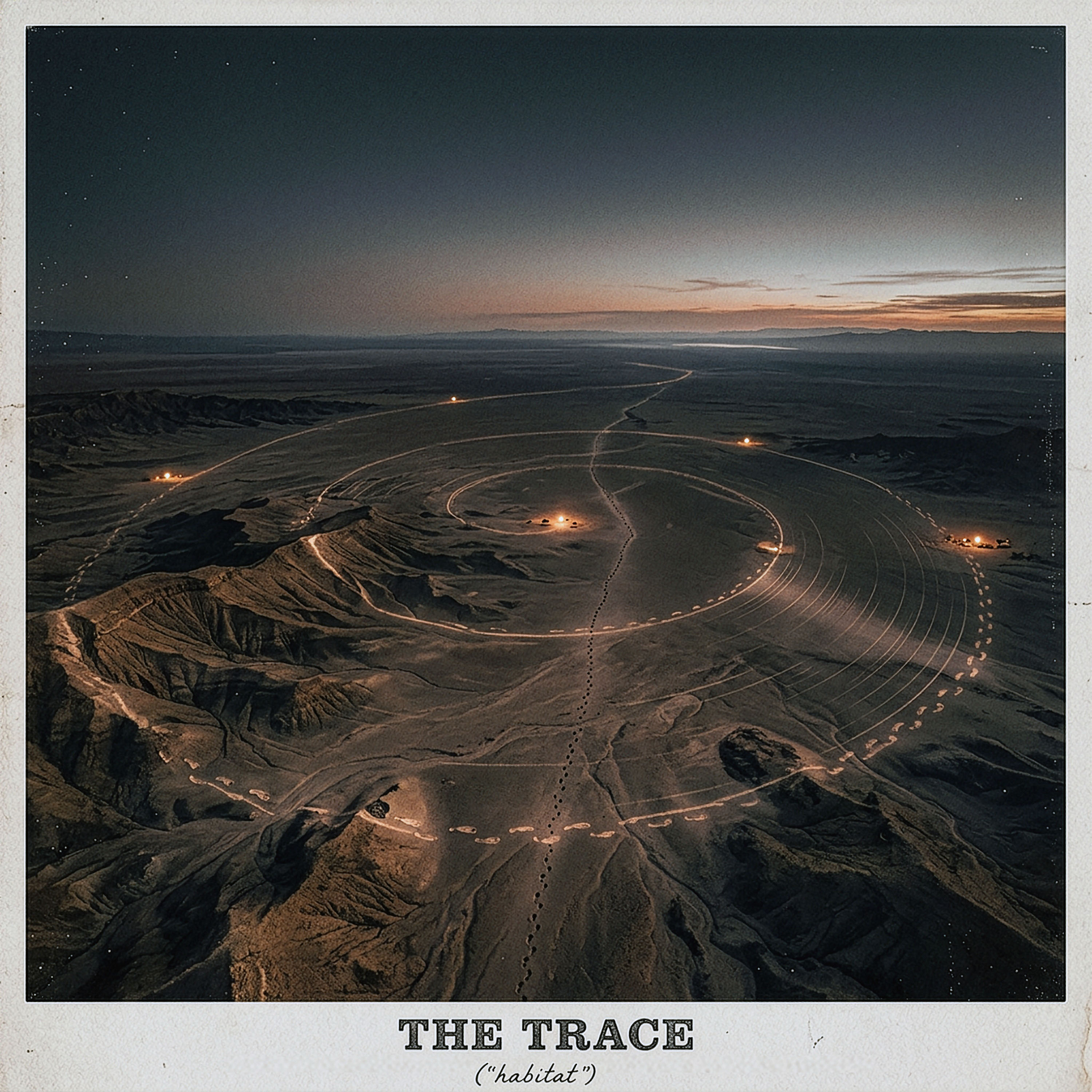
The Trace (Habitat) explores the relationship between human life and the environments that make it possible.
Through images of ancestral memory, land, language and inheritance, the song considers how our lives are shaped by places and histories that existed long before us.
Its central idea is deceptively simple: we do not merely occupy a habitat. We are shaped by it, and through our presence, we change it.
The song moves between the intimate and the expansive. A human voice carries the memory of earlier generations. A landscape holds evidence of those who lived upon it. Language preserves sounds and meanings passed from one life to another.
These are not simply historical records. They are living traces.
The references to Apache heritage and Black Mesa evoke questions of Indigenous belonging, continuity, displacement and the relationship between cultural identity and ancestral land. They invite reflection on what happens when a habitat is threatened, transformed or separated from the people whose lives have developed within it.
Within this landscape, the idea of a trace becomes especially important.
A trace is not necessarily something deliberately preserved. It may be a pathway worn through repeated journeys, a word inherited from an elder, a pattern of behaviour passed between generations or an alteration to the environment that remains long after its originator has gone.
The song suggests that human existence is inseparable from these accumulated consequences.
Musically, its sparse, unquantised arrangement reinforces this sense of continuity. At approximately 68 BPM, the slow pulse creates room for breath, reflection and the natural imperfections of performance.
Folk-inflected textures, understated hip-hop influences and ambient space support a vocal delivery that feels closer to remembrance than declaration.
The music does not attempt to recreate a particular ancestral tradition. Instead, its restrained contemporary language provides space for the themes of inheritance, place and responsibility to emerge.
Within The Invisible Matters, The Trace (Habitat) expands the meaning of human connection beyond immediate relationships.
Our encounters are not limited to other people. We also encounter landscapes, cultures, histories and living environments. These encounters shape us, even when their influence is difficult to measure.
The song asks us to recognise that belonging is not simply a feeling of ownership or familiarity. It emerges through relationship, continuity, care and consequence.
A habitat is therefore more than a physical location.
It is a living arrangement of relationships that allows life to continue.
And every generation inherits both its possibilities and its vulnerabilities.
Verse 1
There’s a blueprint buried in a British stone
An echo-laden Stratocaster left alone
Viner bought the bongos, Viner bought the tape
But you cannot buy the rhythm when it finds a shape
Herc had two copies of a failed design
And a crossfader cutting up a borderline
He wasn’t looking for the singer or the cowboy tune
He was digging for the energy inside the room
Chorus
And the recording is just the evidence
The lineage is the artifact
The system measures inventory
But the habitat is striking back
One song, infinite translations
Passed from hand to hand across the frost
What a machine cannot measure
Is the first thing that it leaves for lost
Verse 2
Now the engineers are staring at the desert floor
They see tonnage in the mesa, they see dollars at the door
They put a gauge upon the water, put a pipeline in the clay
And they pipeline the lifeblood of a thousand years away
But the corn doesn’t grow by the volume of the flow
It grows by the covenant the modern systems never know
They compressed the ancestor into an extractable grid
Blind to the resolution where the healing hid
Chorus
Because the recording is just the evidence
The lineage is the artifact
The system measures inventory
But the habitat is striking back
One song, infinite translations
Passed from hand to hand across the frost
What a machine cannot measure
Is the first thing that it leaves for lost
Bridge
So don’t ask me how to win it
Don’t ask me for the clout
Don’t tell me how to scale it fast
Before the fire goes out
I am leaving a trace in the winter air
I am speaking the vowels that my elders left there
We are neighbors in the margins, adjacencies of light
A field journal entry against the digital night
Chorus
Where the recording is just the evidence
And the lineage is the artifact
The system measures inventory
But the habitat is striking back
One song, infinite translations
Passed from hand to hand across the frost
What a machine cannot measure
Is the first thing that it leaves for lost
Outro
What do you notice?
Not: What do you want?
Do you understand where you are?
Leave your trace.
Let the machinery fade.
We are the lineage.
We are the habitat.
The Trace (Habitat) emerged from an exploration of ancestry, land, lineage and the often invisible connections between human identity and the places in which it develops.
Its imagery of Apache history, Black Mesa and inherited language places the song within a wider reflection on cultural continuity and the consequences of environmental and social change.
The creative approach is deliberately restrained.
Rather than using a large cinematic arrangement to communicate the scale of these ideas, the song relies on intimacy: a slow pulse, sparse instrumentation, natural room ambience and a voice carrying words that feel inherited rather than invented.
One of its central lyrical images expresses this relationship between presence and inheritance:
"I am leaving a trace in the winter air"
The image suggests that even a fleeting human presence participates in something larger than itself.
The song also considers how language carries memory. Words and sounds learned from previous generations become part of the living present, allowing elements of the past to continue through contemporary voices.
This creates a relationship between three dimensions of time: what has been inherited, what is being lived and what will remain.
The title's reference to Habitat introduces a further dimension.
A habitat is not simply the background against which human stories unfold. It actively shapes the conditions under which those stories become possible.
Changes to land, community, culture and environment can therefore alter more than physical surroundings. They can affect belonging, memory and the possibilities available to future generations.
The song's underlying question becomes:
What are we leaving behind in the places that have made us possible?
Rather than offering a definitive answer, The Trace (Habitat) leaves the listener with a sense of continuity and responsibility.
We arrive within histories already in motion.
We participate in their unfolding.
And something of our presence remains.
Ancestry • Habitat • Belonging • Indigenous Heritage • Cultural Memory • Land • Lineage • Inheritance • Environmental Responsibility • Intergenerational Connection • Identity • Continuity • Human Consequence • Presence • The Trace
The Trace (Habitat) explores one of the foundational principles of The Invisible Matters:
Every encounter leaves a trace.
In this song, the encounter extends beyond relationships between individuals to include the living relationship between people, place, culture and history.
Habitat is understood not merely as physical territory but as the conditions through which life, identity and belonging become possible.
The song also reflects a further TIM distinction:
Records are intentional. Traces are inevitable.
We may choose which histories to document, which achievements to celebrate and which stories to preserve. But our actions also leave consequences beyond what we intend or recognise.
These consequences become part of the world inherited by others.
The song therefore asks us to consider not only what we take from our surroundings, but what our presence makes possible—or impossible—for those who come after us.
We inherit a habitat.
We leave a trace.
And the future must live with what remains.

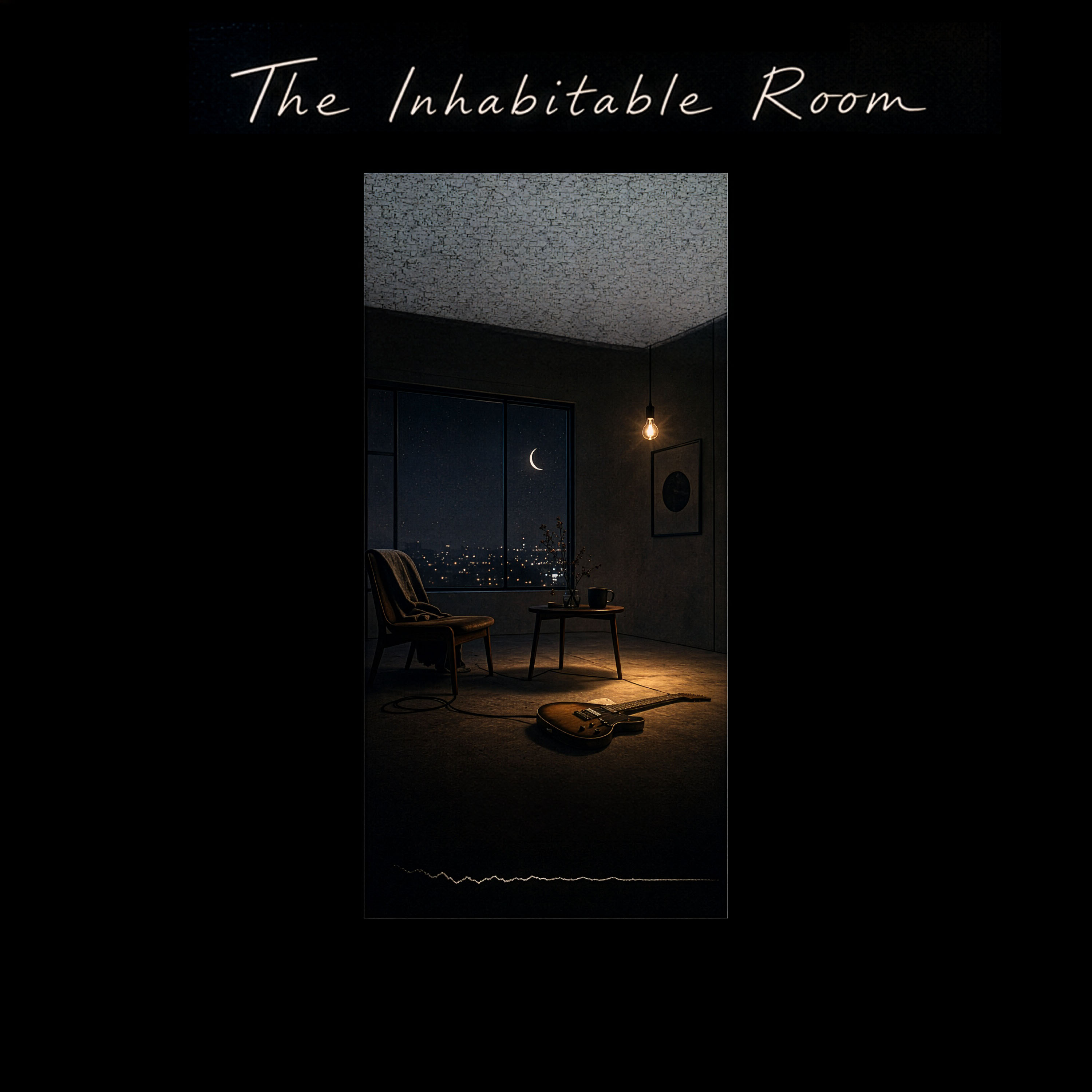
The Inhabitable Room explores the difference between living a life and constantly having to demonstrate that one's life has value.
The song begins by questioning a seductive contemporary belief: that we are the architects of our own existence, and that the quality of our lives is primarily determined by the choices we make.
There is truth in this idea. Human beings possess agency, imagination and the capacity to influence their circumstances.
But agency is not absolute control.
We arrive in a world already shaped by family histories, economic conditions, cultural expectations, institutional structures and social inequalities. Long before we begin consciously designing our lives, many of the conditions within which we must live have already been established.
We are architects building on fault lines we did not create.
Against this backdrop, the song examines a culture increasingly organised around attention, productivity, availability and performance.
People are encouraged to improve themselves, optimise their routines, maximise their potential and continually become better versions of who they are.
Yet the environments demanding this improvement are rarely subjected to the same scrutiny.
What if the difficulty is not simply that people need to become more resilient, efficient or adaptable?
What if many of the environments we inhabit are becoming increasingly difficult to live in?
The musical arrangement makes this tension tangible.
The opening section, The Compression, establishes a tightly controlled electronic environment. Mechanical rhythms, compressed textures and hurried vocals reproduce the sensation of living under continual demands.
There is movement, but little freedom.
The rhythm drives forward, yet the human voice struggles to find space within it.
As the song approaches The Threshold, the mechanical architecture begins to fracture. Elements disappear. The relentless forward momentum becomes less certain.
A boundary emerges.
The music discovers that urgency is not always necessary, and that refusing an imposed rhythm does not mean refusing participation in life.
The final movement, The Coherent Room, introduces a warmer, more spacious musical environment. Organic drums, human timing, natural imperfections and silence replace the earlier sense of mechanical compulsion.
This is not a retreat into passivity.
It is the recovery of a different relationship with the world.
The individual no longer needs to demonstrate constant productivity to justify their presence. There is room to breathe, respond, create, rest and participate.
The song's central declaration captures this transformation:
"You don't have to fracture yourself to remain."
Within The Invisible Matters, this becomes a statement about human dignity and the limits of adaptation.
Not every demand deserves compliance.
Not every measure of performance reflects genuine wellbeing.
And not every successful adaptation represents human flourishing.
An inhabitable environment is not necessarily comfortable, predictable or free from difficulty. It is one in which people can remain human while encountering difficulty.
The song ultimately argues for a more conscious relationship with the conditions of our lives.
We cannot design everything that happens to us.
But we can question the environments we inherit, recognise the pressures they create and participate in changing what becomes possible within them.
Sometimes the most meaningful act of design is not adding another system, expectation or improvement.
It is making room.
**(Verse 1)**
You bought the blueprint, signed the line
The modern gospel says you live by design
That if you stumble, if you fall behind
It’s just a defect in your sovereign mind
They build an engine, tell you it’s a canvas
Overclock the heart to survive the damage
Call it hustle, call it deep devotion
While they monetize your last emotion
**(Chorus)**
But you are an architect building on a fault line
Living in a structure that was built before your time
We don’t begin as blank and open spaces
We begin inside inherited places
And the highest art is not total control
It’s the quiet mercy that can keep you whole
Not bending reality to match the ego's demands
But learning how to live in conditions you didn't choose
**(Verse 2)**
The screen is edge-less, the loops never end
No factory whistle tells the mind to amend
An infinite scroll through an infinite street
A high-performance system of managed depletion
Where rest is just a break for a better production
And every distraction is attention deduction
The body runs a script in the background dark
Scanning the horizon for the metric mark
**(Chorus)**
But you are an architect building on a fault line
Living in a structure that was built before your time
We don’t begin as blank and open spaces
We begin inside inherited places
And the highest art is not total control
It’s the quiet mercy that can keep you whole
Not bending reality to match the ego's demands
But learning how to live in conditions you didn't choose
**(Bridge)**
So drop the tempo, let the signal slow
Introduce a threshold where the panic can go
Leave the noise outside the bedroom door
Belong right here before you score
It’s a metabolic shift, an act of resistance
To stand in the silence and protect your existence
We don’t need to fix what was never broken
We just need a space where the truth can be spoken
**(Outro)**
A civilization of coherent rooms
Built inside the shadows of incoherent dooms
You don’t have to fracture yourself to remain
You don’t have to justify the weight of your pain
Just arrive...
Land the organism...
Tune the instrument...
And play the next note.
The Inhabitable Room developed from a reflection on the idea of living life by design.
The phrase initially suggests empowerment: the possibility of becoming more intentional about our choices, habits, relationships and future.
Yet the concept contains a significant limitation.
If life is entirely a product of personal design, then suffering, exhaustion and difficulty can easily be interpreted as evidence of individual failure.
The song challenges this assumption without denying personal responsibility.
Its central metaphor emerged from the recognition that human beings are architects working within inherited conditions.
Some foundations are stable. Others contain fault lines. Some structures support human flourishing, while others demand continual adaptation merely to remain standing.
This led to the question of what makes an environment genuinely inhabitable.
The musical production became an essential part of the answer.
Rather than presenting a single consistent atmosphere, the song moves through three distinct states.
1. The Compression
The opening uses a rigid electronic groove, tense bass movement, compressed textures and rhythmically urgent vocals.
The arrangement represents the experience of continual demand: attention must be maintained, performance must be demonstrated and every moment appears to require productive use.
The listener experiences pressure not simply through the lyrics but through the musical structure itself.
2. The Threshold
The mechanical rhythm begins to destabilise.
The arrangement loses its certainty, opening a space in which the listener can recognise that the existing pace is not inevitable.
This is the moment of agency.
Not absolute control over circumstances, but the capacity to establish a boundary and question whether the demands being imposed are legitimate.
3. The Coherent Room
The final section settles into an organic, unquantised musical pocket.
Warm instrumentation, human imperfections, natural breathing and greater dynamic space create a fundamentally different experience.
The music does not become meaningful because it has become more efficient.
It becomes inhabitable because its elements have room to coexist.
This transition expresses the song's central philosophical movement: from compulsory adaptation towards conscious participation.
The final musical environment does not erase the conditions established earlier. Instead, it demonstrates that a different relationship with those conditions is possible.
The song ends without claiming that every difficulty has been resolved.
The person remains unfinished.
And that is precisely the point.
Human Dignity • Agency and Constraint • Inherited Circumstances • Self-Optimisation • Productivity Culture • Attention Extraction • Hypervigilance • Environmental Design • Psychological Safety • Boundaries • Human Timing • Belonging Before Performance • Conscious Participation • Structural Responsibility • Human Flourishing • Making Room
The Inhabitable Room marks an important movement within The Invisible Matters philosophy: from examining how human beings are represented and measured towards questioning the environments in which they are expected to live.
Its central distinction is between personal agency and total responsibility.
Human beings can make choices, influence relationships and reshape aspects of their circumstances. But they cannot reasonably be held responsible for every condition they inherit or every pressure imposed upon them.
The song also challenges the assumption that successful adaptation is always evidence of a healthy environment.
A person may become highly effective at functioning within a system that continually diminishes their capacity to live fully.
Performance alone cannot establish flourishing.
This connects directly to TIM's concern with resolution and authority. A measure of productivity may accurately describe one aspect of a person's activity without possessing the authority to determine their overall worth.
The song therefore shifts the central question.
Rather than asking only, "How can people become better at functioning within existing systems?", it asks:
"What would make those systems more inhabitable for human beings?"
This is also where the song connects to MAKE ROOM.
Making room does not mean eliminating structure, responsibility or challenge. It means creating conditions in which structure serves participation rather than demanding that people continually fracture themselves to fit.
The song's deepest principle is expressed in a single line:
"You don't have to fracture yourself to remain."
And its final insight extends beyond music:
A truly inhabitable world is not one in which everyone has perfected themselves. It is one in which people have room to remain human while becoming.
The song has finished, but the person hasn't.


The Invisible Matters™
