The movement is the
world beyond it.



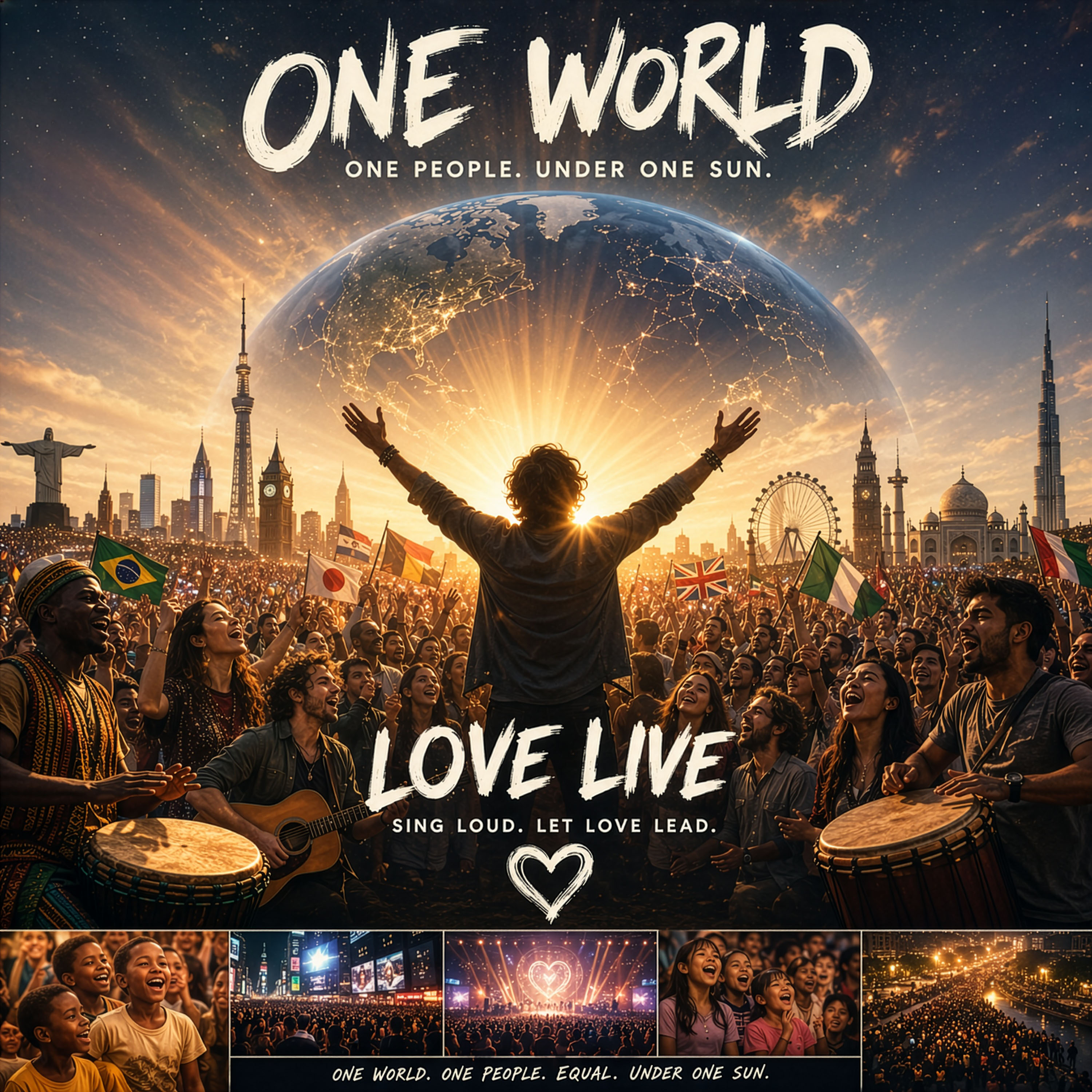
LOVE LIVE imagines what happens when the world stops being an audience to itself and begins participating in a shared human experience.
Inspired by the possibility of a global musical gathering, the song moves beyond the familiar language of unity to explore something more immediate: the extraordinary experience of people, separated by oceans, borders, histories and beliefs, finding themselves connected through the simple act of singing together.
The song begins intimately.
One voice. One breath. One person listening.
Across the world, people are living different lives. Some are celebrating. Some are grieving. Some are struggling to be heard. Others are simply getting through another ordinary day.
Their experiences are not interchangeable. Their circumstances are not equal. Their stories cannot be reduced to a single universal narrative.
Yet something travels between them.
A rhythm. A melody. A voice answered by another voice.
As the music grows, the song moves through different cultural and rhythmic landscapes, reflecting the diversity of the people participating. Organic percussion, Afro-rhythmic movement, acoustic instrumentation, soulful vocals and communal harmonies gradually create a musical gathering that feels both intimate and enormous.
The chorus introduces the central invitation:
One World. One Stage.
Not because the world has become one culture, one opinion or one identity, but because everyone can contribute something without surrendering who they are.
At the emotional centre of the song, the instruments disappear.
The world is invited to sing:
One World. One People. Equal. Under One Sun.
For a moment, there is no featured performer, no headline artist and no audience separated from the stage.
There are simply people making music together.
The final chorus returns with the accumulated energy of that participation. What began as one voice has become an immense human chorus, not through uniformity but through contribution.
LOVE LIVE does not suggest that singing together resolves injustice, conflict or inequality.
Instead, it asks a different question:
What might become possible when people experience one another as participants in a shared world rather than strangers competing for space within it?
The song ends without declaring the world healed.
The music has brought people together for a moment.
What they do with that moment remains theirs to decide.
[Intro]
If you listen close
You can hear it now
Under every street
Under every crowd
Different names
Different skies
Same human tears
Same human eyes
[Verse 1]
From the red dusk hills
To the neon rain
From the desert wind
To the subway train
Every language carries
A hopeful sound
Every broken heart
Wants to be found
[Pre-Chorus]
And tonight
The world turns slowly toward the light
No one standing here alone
[Chorus]
One world
One stage
One voice rising through every age
Hands high
Hearts brave
We are more than the lines we made
Sing loud
Let love lead
Across every colour, every creed
Under one sun
We become
A million hearts beating as one
Oh-oh-oh
LOVE LIVE
Oh-oh-oh
LOVE LIVE
[Verse 2]
Tokyo calling
Lagos sings
London lights and church bells ring
Rio dancing into dawn
New York holding the rhythm on
Every border starts to fade
When a human voice is unafraid
[Pre-Chorus]
And tonight
The shadows open into light
No one standing here alone
[Chorus]
One world
One stage
One voice rising through every age
Hands high
Hearts brave
We are more than the lines we made
Sing loud
Let love lead
Across every colour, every creed
Under one sun
We become
A million hearts beating as one
[Bridge]
(Everything strips back.
Only percussion and voices remain.)
No kings
No crowns
No lost and found
Just human sound
One breath
One sky
One moment
Alive
“One World.”
(Crowd repeats)
“One People.”
(Crowd repeats)
“Equal.”
(Crowd repeats)
“Under One Sun.”
(Huge global crowd response)
[Final Chorus]
One world
One stage
Every soul turning another page
Hands high
Hearts brave
This is the moment we create
Sing loud
Let love lead
Planting hope like a living seed
Under one sun
We become
A million hearts beating as one
[Outro]
(Crowds from different cities fade in and out.
Children singing.
Drums continue like a heartbeat.)
Oh-oh-oh
LOVE LIVE
Oh-oh-oh
LOVE LIVE
LOVE LIVE emerged from the idea of creating a global live music event inspired by the cultural impact of Live Aid, but fundamentally different in its relationship with the audience.
Rather than broadcasting a concert from a small number of stages to viewers around the world, LOVE LIVE imagines the world itself becoming the stage.
Cities across different time zones contribute performances, passing the music from one region to another as the Earth turns beneath the sun.
Tokyo, Lagos, London, Rio, New York and countless other communities become part of a continuous musical conversation.
The concept connects directly with #SingThisOneSong, where a shared composition becomes the starting point for countless interpretations.
One song can be sung in different languages, rearranged into different genres, performed by professionals or amateurs, and transformed through the creative contributions of people who may never meet.
The original composition provides a common point of departure, not a compulsory destination.
This principle informs the song's musical architecture.
The opening is deliberately intimate, allowing one human voice to establish emotional contact before the production expands.
The verses acknowledge distance and difference.
The pre-choruses create anticipation.
The chorus offers a simple, memorable musical invitation that can be sung by people of different ages and musical abilities.
The instrumental arrangement draws from global rhythmic traditions without suggesting that any one tradition represents the entire world.
The defining moment arrives when the production falls silent and the collective voice takes over.
This is the moment when LOVE LIVE becomes more than a song about participation.
Participation becomes the performance itself.
The eventual ambition is for the composition to remain recognisable while allowing different communities to reshape its rhythm, language, instrumentation and emotional character.
The song belongs to the event, but its meaning develops through the people who sing it.
LOVE LIVE is a musical expression of a central principle within The Invisible Matters:
Reality exceeds every encounter.
No single voice can represent the whole world.
No single performance can contain every human experience.
No single interpretation of a song can claim complete authority over what that song might become.
The composition therefore provides a shared structure without demanding a shared identity.
This distinction is fundamental.
The intention is not to demonstrate that humanity is already united, nor to use music as evidence that its divisions have disappeared.
It is to create an encounter in which people can contribute, listen, respond and remain different.
Within the TIM framework, this also reflects the principle:
Authority ≤ Resolution.
A moment of collective singing may reveal connection, but it cannot establish agreement on every issue or claim to speak for every participant.
The experience is meaningful precisely because it does not need to make those claims.
The relationship with #SingThisOneSong extends this principle into creative practice. The original song is an invitation to interpretation, not an authoritative version against which all others must be judged.
Each rendition becomes another encounter with the composition.
Each encounter leaves a trace.
Each contribution creates the possibility of something that did not previously exist.
LOVE LIVE also embodies the wider creative philosophy of MAKE ROOM and RENDITION. NOT AN AUDITION.
The purpose is not to identify the world's best singer.
It is to make room for the world to sing.
Ultimately, LOVE LIVE proposes that shared human experience need not depend upon sameness, perfection or unanimous agreement.
The stage can be shared without being owned by any one voice.
And when the final note disappears, the human encounter continues.
The song has finished, but the person hasn't.
Archive Closing Thought
One world does not mean one version of the world.
One stage does not mean one voice.
One song does not mean one way to sing it.
LOVE LIVE.
One World. One Stage.
The world doesn't just watch. The world performs.

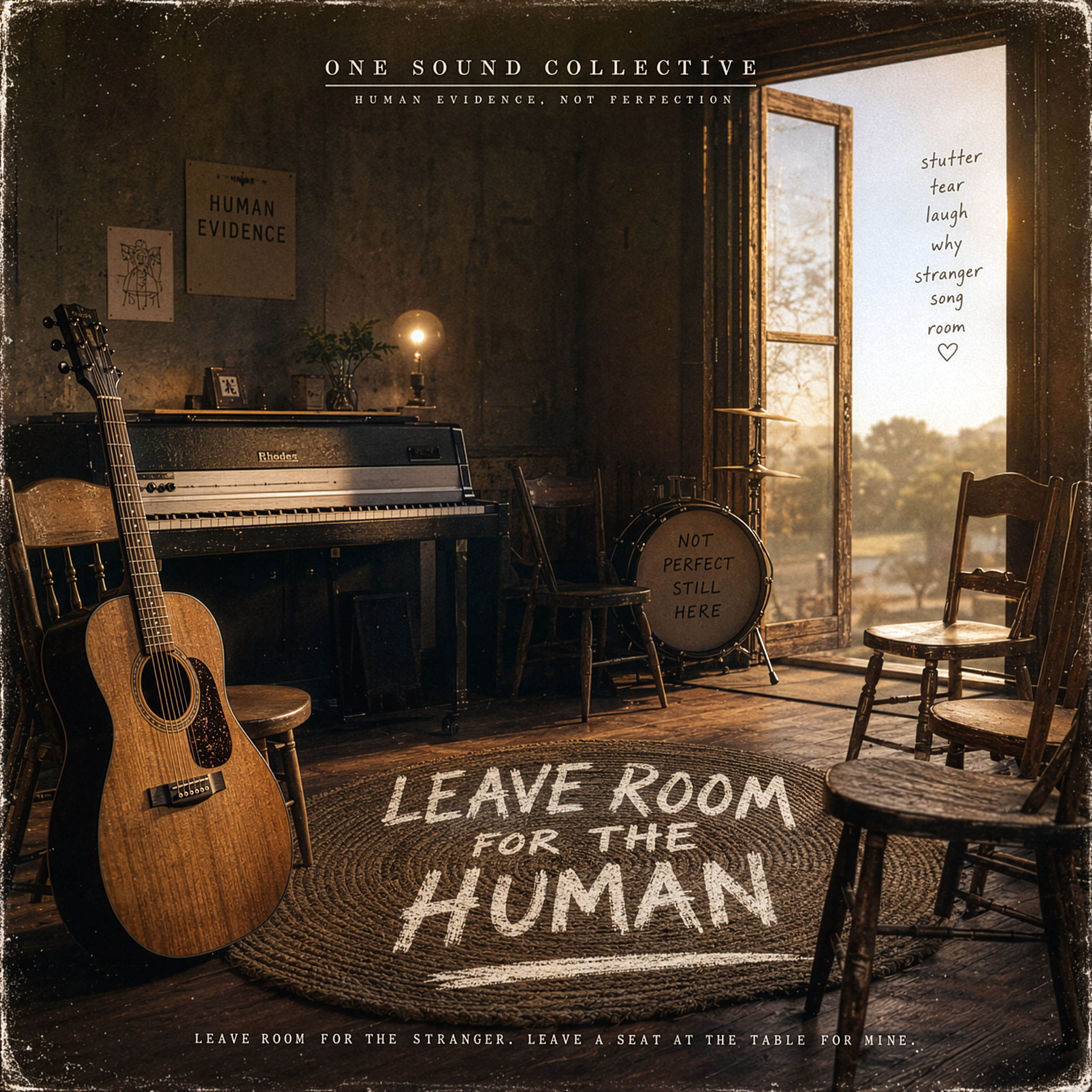
Leave Room for the Human is not a protest against artificial intelligence or technological progress. It is a design requirement for the future: whatever we create, improve or automate, we must leave room for the human beings who will live within it.
Set against a warm, organic folk-gospel arrangement, the song explores a world becoming increasingly seamless, predictable and frictionless. Screens anticipate our attention, systems smooth away inconvenience, and the rough edges of everyday life gradually disappear.
Yet something essential lives within those very edges.
A stumble. A cracked voice. A sleepless night. The weight of wood in someone's hands. A wrong note played at the end of a song.
These moments are not simply imperfections waiting to be corrected. They are traces of lived experience, evidence of people encountering a world that cannot be entirely predicted or controlled.
The song moves from observing a carefully arranged world toward recognising what might disappear when everything becomes too carefully arranged.
Its emotional centre emerges in the bridge, where the singer asks for something beyond the preservation of individual humanity:
Leave room for the stranger to sing along.
Leave room for the listener to finish the song.
Here, the song undergoes its most important transformation.
It stops asking merely for humanity to be protected and begins inviting another person to participate.
The listener is no longer simply receiving a finished piece of music. There is space for another voice, another interpretation, another experience.
Musically, the arrangement embodies this invitation. Fingerpicked acoustic guitar, warm Rhodes piano, gently wandering bass and sparse brushed drums establish an intimate, breathing foundation. The groove remains deliberately unquantized, allowing the musicians' natural timing to shape the performance.
As the song progresses, its emotional expansion comes not from technological spectacle but from the gradual arrival of other people.
The final chorus becomes a gathering of individual voices, loosely united in a communal gospel refrain. Their differences remain audible. Nobody needs to sing perfectly to belong.
The recording concludes with instruments falling away, leaving the sound of the room itself: a chair moving, fingers sliding across strings, a breath, an amplifier humming.
The song has finished.
But the person hasn't.
And somewhere beyond the recording, another voice may still be singing.
(Verse 1)
The screen already knows where my eyes will go
Predicting the hunger, directing the flow
A seamless floor from the bed to the street
Not a stone out of place for the soles of my feet.
We’re smoothing the pavement, erasing the miles
Hiding the fractures behind identical smiles
But I miss the stumble, the catch in the throat
The weight of the wood in a handmade boat.
(Chorus)
Oh, leave room for the human, leave room for the ghost
In the spaces between what we calculate most.
Give me the stutter, the tear in the eye,
The unprompted laugh and the unexplained why.
Before we erase every flaw from the design,
Leave room for the human... leave room for mine.
(Verse 2)
You can mimic the masters, paint the whole sky
A beautiful copy that catches the eye.
But where is the midnight? Where is the sweat?
The pacing the floor when the ink isn’t wet?
The kettle still whistles but nobody waits,
The screen doors are swinging on unlocked gates.
Don't polish the stone till the character’s gone
I don't want a paradise I can’t bleed upon.
(Chorus)
So leave room for the human, leave room for the ghost
In the spaces between what we calculate most.
Give me the stutter, the tear in the eye,
The unprompted laugh and the unexplained why.
Before we erase every flaw from the design,
Leave room for the human... leave room for mine.
(Bridge)
It’s the wrong note played at the end of the song
That lets everybody know we’ve been here all along.
It’s the spill on the linen, the slip of the tongue,
The desperate anthem that’s awkwardly sung.
Don’t quiet the static. Don’t steady the hand.
Leave a little dirt on this plot of land.
And leave room for the stranger to sing along...
Leave room for the listener to finish the song.
(Chorus)
Oh, leave room for the stranger, leave room for the ghost
In the spaces between what we calculate most.
Give me the stutter, the tear in the eye,
The unprompted laugh and the unexplained why.
Before we erase every flaw from the design,
Leave room for the stranger... leave a seat at the table for mine.
(Outro)
Leave a little room...
Just a wide open space.
For the heavy heart,
And the saving grace.
The song began as an indie-acoustic/synth-pop reflection on artificial intelligence, automation and the increasing pursuit of technological perfection.
Its original lyrics directly referenced algorithms, generated creativity and the optimisation of everyday life.
During development, a more meaningful direction emerged.
Rather than explaining the risks of technological progress, the song could reveal the human experiences worth preserving.
This led to a structural revision centred on physical imagery, emotional vulnerability and sensory detail.
The phrase Human Evidence became central to the production philosophy.
Breaths, string friction, room resonance, loose timing and imperfect vocal entrances would not be treated as recording defects. They would become audible traces of an encounter.
The musical direction evolved toward organic folk-gospel and raw indie-soul, with an additional exploration of the warm, emotionally immediate, live-band character associated with 1970s Laurel Canyon folk-rock and Daisy Jones & The Six.
However, the final creative direction retained its contemporary philosophical foundation rather than becoming a nostalgic recreation.
A defining lyrical development occurred with the introduction of two lines:
Leave room for the stranger to sing along.
Leave room for the listener to finish the song.
These transformed the work from a defence of human imperfection into an invitation to human participation.
The song's central concern is therefore not whether machines can reproduce aspects of human creativity.
It is whether the worlds we construct continue to offer people meaningful opportunities to contribute, encounter one another, change direction and remain unfinished.
Production principle: The music should not merely describe human presence. It should make room for it to become audible.
Leave Room for the Human expresses a central principle within The Invisible Matters and the wider High-Resolution Human body of work:
A world can become more technically sophisticated without becoming more humanly complete.
The song does not position technology as an enemy, nor does it romanticise imperfection as inherently virtuous.
Instead, it questions the assumption that removing uncertainty, friction and unpredictability necessarily improves human experience.
A technically accurate representation may still be incomplete. A perfectly executed performance may still leave little room for another person's contribution. A seamless environment may reduce inconvenience while also narrowing opportunities for discovery.
Within the TIM architecture, this distinction matters.
Truth is not total jurisdiction. Authority must remain proportionate to resolution.
What can be measured, predicted or reproduced should not automatically determine the limits of what can be experienced, valued or created.
The song's deeper proposition is relational.
Leaving room for the human means leaving room for someone whose arrival, response or contribution cannot be fully anticipated.
It means recognising that the person encountering the work is not merely evidence of its success, but someone whose own experience exceeds the work's design.
This connects directly with the TIM principle:
Human Consequence, Not Human Evidence.
The recording may preserve traces of a human performance, but those traces are not proof of humanity, nor are imperfections valuable simply because they are imperfections. What matters is the possibility of meaningful human consequence: the capacity to affect and be affected by another person.
The final invitation therefore carries the song beyond its original technological context.
Leave room for the stranger to sing along.
Leave room for the listener to finish the song.
The work is offered, not imposed.
The room remains open.
TIM Closing Thought:
We do not need to make the world less extraordinary to keep it human.
We need to make sure that, whatever we build, there is still room for someone else to arrive.
Make. Leave. Return.


The Invisible Matters™
