The movement is the
world beyond it.

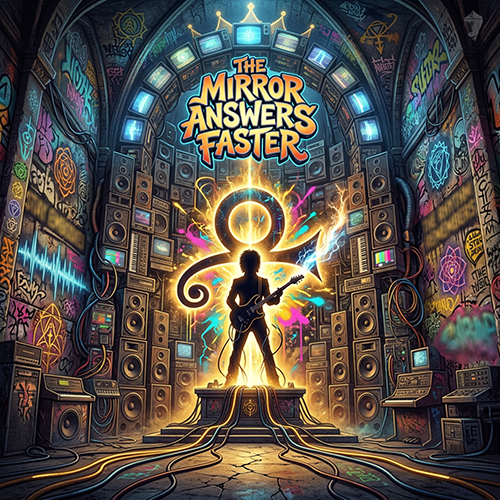

The Mirror Answers Faster examines what happens when technology becomes increasingly capable of anticipating, predicting, and responding to human behaviour before conscious reflection has fully occurred. Built around the contrast between machine precision and human spontaneity, the song explores the tension between algorithmic efficiency and embodied experience. At its surface, the song presents a world saturated by screens, metrics, predictive systems, and digital identities. Mirrors no longer simply reflect reality; they anticipate it. Feeds predict desires, platforms map behaviour, and systems increasingly know what people might do before individuals fully understand themselves. The result is a subtle form of displacement, where technological responsiveness begins to outpace human self-awareness. Beneath this critique lies a celebration of the human body as a source of intelligence in its own right. Rhythm, breath, touch, memory, vulnerability, and improvisation become forms of knowledge that cannot be fully reduced to data. Throughout the song, the machine is associated with precision, prediction, and optimisation, while the body represents spontaneity, relationship, feeling, and lived experience. Within the wider TIM ecosystem, The Mirror Answers Faster represents one of the clearest expressions of the High-Resolution Human philosophy. Rather than framing technology as an enemy, the song highlights the importance of maintaining a connection to forms of intelligence that emerge through embodiment. The question is not whether machines can think, but whether people remain connected to the deeper dimensions of being human. The song's structure reinforces this message. Quantised sections gradually give way to looser grooves, audible breath, rhythmic imperfection, and collective release. The movement mirrors the journey from external control toward internal sovereignty. By the time the song reaches its final moments, the emphasis has shifted entirely from technological prediction to human presence. Ultimately, The Mirror Answers Faster suggests that meaning cannot be fully automated. Systems may accelerate information, but they cannot replace the choices that emerge through conscious participation. The body keeps the meaning because the body remains the place where experience becomes real.
[VERSE 1 — 100% Quantized] Dark room, bright screen A million ghosts inside the machine I catch my eye in the midnight glass Watching the high-res shadows pass I haven’t spoken, but the feed already shows Where the blood-flow ends and the data-stream flows Every screen knows my face and my frame But nobody here remembers my name We traded sacred chemistry For a beautifully manicured cage Static humming through the wires While the soul burns out on stage [PRE-CHORUS — The Grid Begins To Slip] I can feel your signal underneath my skin Tell me where the waveform ends and the body begins Touch me like a memory the system couldn’t keep Sweat against the algorithm while the city falls asleep [CHORUS — The Grid Is OFF] The mirror answers faster (Faster than my soul) I need a human touch, baby (Before I lose control) The mirror answers faster (Faster than my soul) I need a holy distortion To make me feel whole [SUBCONSCIOUS MANTRA] The rhythm remembers… Stay embodied… Hold your thread… The rhythm remembers… [VERSE 2 — Beautifully Unquantized] Static between souls, a beautiful rebellion They want my devotion, but I am a hellion A sovereign section, a wild variation Breaking the chains of their synchronization They map the desire before it hits the brain Then sell us back our ecstasy and pain But the rhythm remembers what the code forgot They want it clean, but we want it hot High-resolution heart in a low-fidelity world Watch the signal fracture, watch the body unfurl [CHORUS] The mirror answers faster (Faster than my soul) I need a human touch, baby (Before I lose control) The mirror answers faster (Faster than my soul) I need a holy distortion To make me feel whole [SUBCONSCIOUS MANTRA] The rhythm remembers… Stay embodied… Hold your thread… Stay embodied… [THE SEPARATION] Only the human… …can make the choice. [GUITAR SOLO] (No lyrics) [OUTRO] Breathe centered (Return) Hold your thread (The battle is won) (Long pause. Human breath.) The body keeps the meaning.
The Mirror Answers Faster emerged from reflections on artificial intelligence, predictive systems, social media, and the growing speed with which technology increasingly mediates human experience. The song began with a simple observation: modern systems often respond before people have fully processed their own thoughts, emotions, or intentions. Unlike earlier TIM songs that approached these themes through contemplation, this composition explores them through embodiment. The contrast between rigid machine-like structures and increasingly human rhythmic freedom became central to the song's design. The music itself became part of the argument. Within the TIM catalogue, the song represents a movement from reflection toward liberation. It extends themes first explored in Mirrors Answer Faster, Hold Your Thread, and Signal Integrity while shifting the focus toward lived experience. The body is no longer merely discussed; it becomes the primary site of resistance, meaning, and reconnection. The recurring phrase "The rhythm remembers" captures the song's central insight. Beneath technological acceleration, algorithmic prediction, and digital mediation, human beings retain capacities for intuition, presence, creativity, relationship, and choice that cannot be fully automated. These capacities remain available whenever individuals reconnect with their embodied experience. The song ultimately proposes that the future will not be determined solely by what technology can do, but by whether human beings remain willing to inhabit themselves fully while using it. Key Themes Embodiment • Artificial Intelligence • Rhythm • Human Agency • Presence • Choice • Liberation • Identity • Technology • Creativity • Consciousness • High-Resolution Humanity

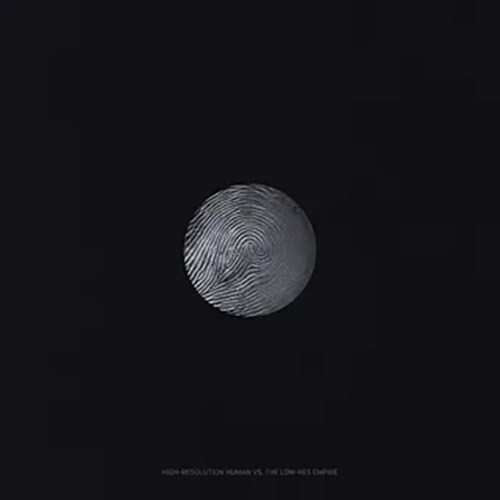
LOW-RES EMPIRE explores the growing tension between the richness of human experience and the systems increasingly designed to simplify, compress, and monetise it. Through themes of technology, media, attention, identity, and social fragmentation, the song examines what happens when efficiency becomes more highly valued than meaning. At its surface, the song presents a critique of contemporary digital culture. Information streams endlessly, attention becomes a commodity, and human experience is increasingly translated into measurable forms. The lyrics describe a world where signals multiply while understanding diminishes, where connection becomes performance, and where the pursuit of optimisation gradually displaces the complexity of lived reality. Beneath its social commentary lies a broader philosophical concern. The song argues that many modern systems operate by reducing dimensionality. Nuance becomes certainty. Relationships become transactions. Identity becomes data. Presence becomes engagement. The "Low-Res Empire" functions as a metaphor for any structure that prioritises simplification over depth and extraction over meaning. Within the wider TIM ecosystem, LOW-RES EMPIRE serves as a foundational statement of the High-Resolution Human philosophy. It gathers themes explored across earlier works—acceleration, identity, embodiment, signal integrity, attention, and belonging—and organises them into a coherent framework. The central conflict is not between humanity and technology but between reduction and depth. The recurring image of the "High-Resolution Human" represents an alternative orientation toward life. Rather than existing as a political movement or ideology, it reflects a commitment to remaining present, conscious, relational, and fully engaged with reality despite pressures toward simplification and distraction. As the opening track of High-Resolution Human Vs. The Low-Res Empire, the song establishes the album's central question: how do human beings preserve depth in environments increasingly optimised for speed, certainty, and control?
[Verse 1] War buys hella fire. As lawlessness breaks loose. The world takes over, With the abuse of the use. Truth dies in the wires, As the signal gets reduced. Everybody scrolling, But nobody sees the truth. Screens glow through the silence, While the real world falls mute. Love gets algorithmic, And the soul becomes a loop. Higher towers rising, Lower frequencies in the youth. We traded human texture, For the smoothness of the spoof. [Chorus] High-resolution human, In a low-res empire. Trying to stay conscious, While the whole world’s wired. One world turning, Under one sun. Still searching for the signal, Still trying to become. [Verse 2] They digitized the hunger, Then they monetized the ache. Put a filter on the fracture, Just to see how much we’d take. Now the static is a symphony, The feedback is a friend. We’re streaming the apocalypse, And liking it again. The code is getting cleaner, But the hands are getting cold. Another upgrade for the prison, Another downgrade for the soul. You can’t compress the spirit, Though they try to fit the shape. We are more than just the numbers, In their rendering of fate. [Chorus] High-resolution human, In a low-res empire. Trying to stay conscious, While the whole world’s wired. One world turning, Under one sun. Still searching for the signal, Still trying to become. [Verse 3 — Signal Degradation] They mapped the aura, Then they sold the shade. A high-def copy Of the things we made. The pulse is looping On a data grid, Forgetting everything The ancestors did. The algorithm knows What hurts the most— We’re worshiping the wire, And we’ve hung the ghost. [The Pivot — Dry Vocal / Zero Effects] You can’t compress the spirit, Though they try to fit the shape. We are more than just the numbers, In their rendering of fate. [Outro — Signal Searching for Signal] Disconnect the feed. Feel the texture of the skin. This is where the code ends. This is where we begin. High-resolution human… Underneath the wire. [Ghost Transmission — Buried in Tape Hiss] One world turning… Under one sun…
LOW-RES EMPIRE emerged from years of observing how modern systems increasingly shape attention, identity, relationships, and culture. The song began as an attempt to articulate a pattern that appeared across technology, media, economics, and social life: the tendency to reduce complex human realities into simplified, measurable forms. As The Invisible Matters evolved, this pattern became central to a broader framework. The phrase "Low-Res Empire" emerged as a metaphor for environments that prioritise efficiency over wisdom, visibility over belonging, stimulation over fulfilment, and optimisation over meaning. The song became a way of naming that condition. Within the album, LOW-RES EMPIRE functions as the opening diagnosis. It identifies the forces that many later tracks will examine in greater detail while introducing the counterpoint represented by the High-Resolution Human. The conflict is not external alone. It also exists within everyday choices about attention, perception, relationships, and participation. The song's concluding invitation—"Disconnect the feed. Feel the texture of the skin."—captures its essential proposition. The path toward greater resolution begins not through escape from technology but through reconnection with lived experience. Human depth survives wherever people remain willing to inhabit reality directly. Key Themes Attention • Technology • Reductionism • Signal Integrity • Humanity • Presence • Identity • Consciousness • Digital Culture • Meaning • Resistance • High-Resolution Living
.png)
Human Timing explores the possibility that many contemporary struggles arise not from a lack of capability but from a mismatch between the pace of modern systems and the rhythms of human life. Through themes of presence, embodiment, attention, and resistance, the song examines what becomes possible when individuals reconnect with slower, more natural forms of perception and experience.
At its surface, the song is a gentle invitation to slow down. It contrasts the relentless pressures of productivity, measurement, and optimisation with the body's deeper intelligence—breath, heartbeat, rest, relationship, and presence. The lyrics suggest that human beings possess an ancient rhythm that predates technology, economics, and digital culture, a rhythm that remains available beneath the noise of contemporary life.
Beneath its calm exterior lies a subtle critique of acceleration culture. The song questions systems that attempt to quantify every aspect of experience, transforming attention, sleep, emotion, and even human connection into measurable outputs. Rather than rejecting innovation, Human Timing proposes that wisdom emerges when technological progress remains aligned with human needs rather than replacing them.
Within the wider TIM ecosystem, Human Timing represents one of the clearest articulations of the project's philosophy of recalibration. If LOW-RES EMPIRE identifies the forces that fragment attention, Human Timing demonstrates how coherence can be restored. The song shifts the focus from diagnosis to practice, inviting listeners to inhabit time differently.
The dub section is particularly significant. As instruments gradually disappear and space becomes the primary musical element, absence itself becomes expressive. Echoes drift through silence, fragments become memories, and the listener is invited to experience music not only as sound but as relationship. The emptiness becomes part of the composition.
As the second track on High-Resolution Human Vs. The Low-Res Empire, Human Timing functions as a corrective lens. It reminds listeners that being fully human may require less optimisation and more participation in the rhythms already present within life itself.
Intro
Verse 1: Reconnection
Kick off your shoes, let the floor hold your weight
The world outside the window is still running late
Let the city rush by, let the satellites spin
We’re changing the clock from the room we are in
Listen close to the blood, listen close to the bone
It’s the oldest rhythm that we’ve ever known
No need to perform, no need to explain
Just drop the defense, and let go of the strain
Chorus
Oh, we’re stepping back into human timing
Slow down the pulse, let the alignment take hold
Yeah, we’re stepping back into human timing
Nothing to chase, let the story unfold
(Choir response)
Let it unfold...
Verse 2: Quiet Resistance
They keep stretching the days, trying to optimize light
Putting numbers on breath, putting data on night
Every signal is screaming, trying to capture the eye
But the spirit gets heavy when the speed is too high
A soul cannot track, and it cannot be sold
There are languages here that the wires cannot hold
We are more than the numbers they want us to be
In the space between seconds, we are totally free
Chorus
Oh, we’re stepping back into human timing
Slow down the pulse, let the alignment take hold
Yeah, we’re stepping back into human timing
Nothing to chase, let the story unfold
The Dub Transition: The Architecture of Absence
(The song drops into expansive dub space. Echoes drift through silence.)
Echo Fragment 1:
"...the room we are in..."
Echo Fragment 2:
"...human..."
Echo Fragment 3:
"...wires cannot hold..."
Outro: The Final Exhale
(Only bass heartbeat and tape hiss remain.)
Lead Vocal (whisper)
"...human timing..."
(Tape machine clicks off.)
(Total silence.)
Human Timing emerged from a growing awareness that many forms of modern stress stem from living according to rhythms that human beings were never designed to sustain. As conversations surrounding productivity, optimisation, artificial intelligence, and acceleration became increasingly prominent, the song began as an attempt to identify what might be lost when speed becomes the dominant cultural value.
Drawing inspiration from roots reggae, dub, contemplative traditions, and systems thinking, the song explores the idea that coherence cannot be forced. Human beings possess biological, emotional, and relational rhythms that operate according to principles very different from those governing machines and markets.
Within the High-Resolution Human Vs. The Low-Res Empire album, Human Timing functions as a practical response to the diagnosis introduced by LOW-RES EMPIRE. Rather than offering solutions through ideology or argument, the song demonstrates an alternative mode of being. Its slower pulse, spacious arrangement, and emphasis on absence create an environment rather than a message.
The dub section became central to this intention. By allowing echoes, silence, and negative space to carry meaning, the song invites listeners to experience what happens when attention is no longer constantly occupied. In that space, something older and deeper becomes audible.
Ultimately, Human Timing proposes that progress is not measured solely by how fast humanity can move. It is also measured by whether people remain capable of hearing the rhythms that make life meaningful.
Key Themes
Presence • Timing • Recalibration • Reggae • Dub • Attention • Embodiment • Slowness • Human Rhythm • Resistance • Silence • Coherence
TIM Archive Note
Human Timing introduces one of the central practices of the TIM philosophy: the deliberate restoration of pace. It serves as a musical antidote to the acceleration diagnosed in LOW-RES EMPIRE, demonstrating that slowing down is not withdrawal from life but a deeper participation in it.


The Invisible Matters™
.svg)